Space Shuttle Columbia at White Sands Landing — Original Kodak Photograph, STS-3 View Watchlist >
Seller Accepts Credit Cards
Payment and pickup instructions will be available on your invoice (under "My Account") at the conclusion of this auction.
Pickup
$0.00
($0.00 as additional item)
Signature Confirmed Shipping
$12.90
($12.90 as additional item)
Lot # Nasa88
System ID # 29274782
Start Date
End Date
1 Watching
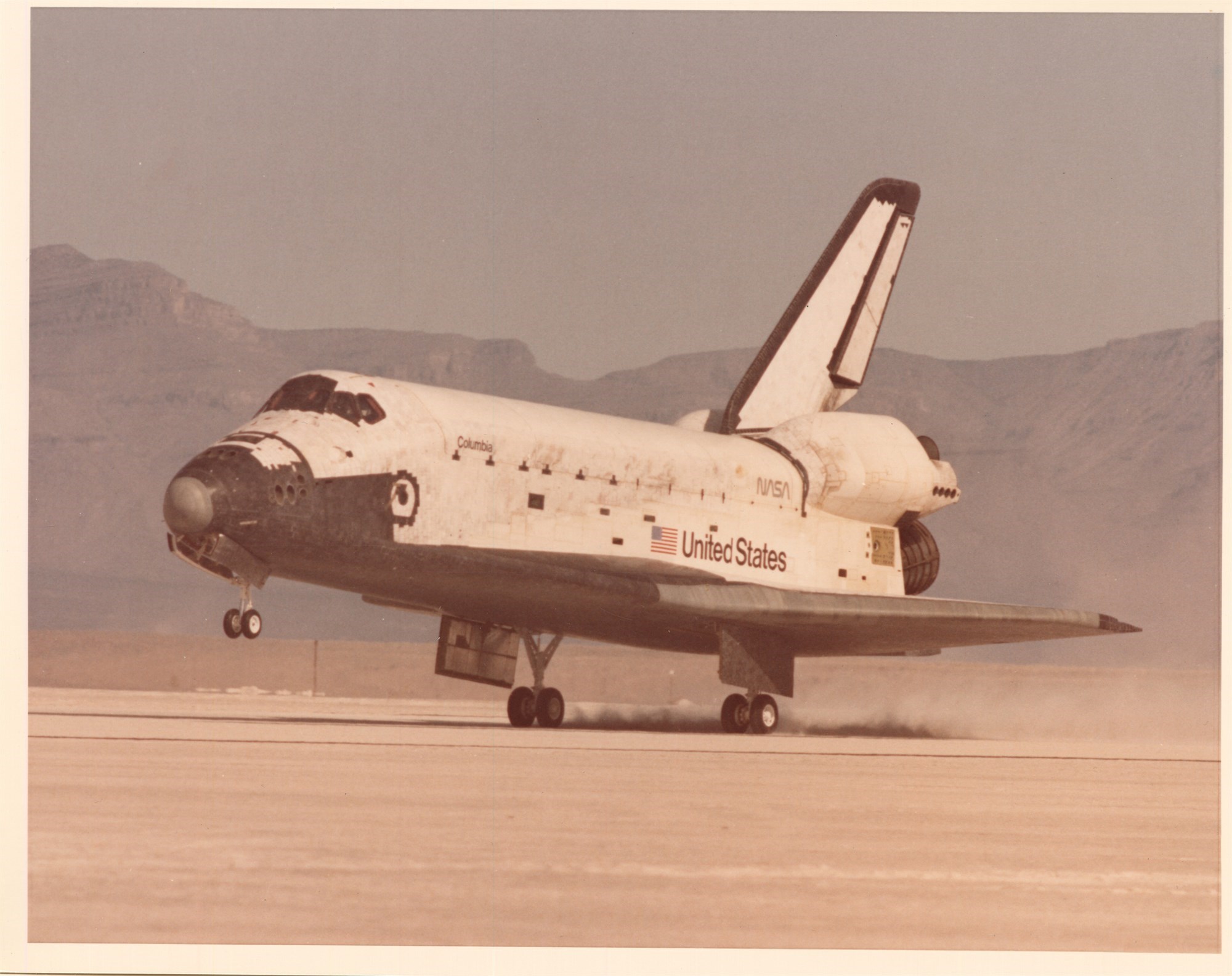
Space Shuttle Columbia at White Sands Landing — Original Kodak Photograph, STS-3
The nose gear is still off the ground. Main gear down, a haze of pale gypsum dust rising from the wheels, the Sacramento Mountains dissolving into the basin haze behind her — this is Space Shuttle Columbia at the precise moment of touchdown at White Sands Space Harbor on March 30, 1982. The orbiter is shown in full port profile: reentry scorching dark across the forward fuselage and thermal protection tiles, the "United States" markings and U.S. flag crisp along the payload bay, the NASA worm logo aft, and the name Columbia legible on the forward fuselage just aft of the crew cabin. She has been in orbit for eight days. She is home — briefly, and in a place NASA never planned for and never returned to.
Printed on Kodak photographic paper, the verso carries the repeating "THIS PAPER MANUFACTURED BY KODAK" watermark with no agency stamp, no press caption wire service mark, and no NASA photo distribution number. That absence is meaningful. Official NASA press photography from the Shuttle era was heavily documented, captioned, and distributed through identifiable channels. Army documentation of the White Sands recovery and departure operated differently. This print's origin outside the NASA photo distribution system — blank-backed Kodak paper, no caption, no agency identifier — marks it as an internal record rather than a release photograph, consistent with its origin in the collection of a retired White Sands Missile Range Army employee. For collectors focused on the Shuttle program, New Mexico space history, or White Sands Missile Range documentation, that distinction places this in a genuinely narrow category of surviving material.
Significance & Rarity
No other Shuttle mission touched down at White Sands — not before STS-3, not after. Rain at Edwards Air Force Base forced the diversion to the Tularosa Basin; high winds then delayed the landing by a full day, extending the mission to eight days in orbit. When Columbia finally rolled to a stop on Northrup Strip's gypsum runway, the dust it ingested during rollout damaged seals and systems severely enough that NASA formally removed White Sands from future consideration as an operational landing site. The site remained on the contingency list but was never again used. One mission. One landing. The March 30, 1982 touchdown is the only photographic subject of its kind that can exist — Columbia on the gypsum flats, the Sacramento Mountains behind her — and press access to a remote desert recovery site with no established media infrastructure meant that period original prints from that day are genuinely uncommon in the collector market. Those placing Columbia squarely against the recognizable White Sands mountain backdrop carry geographic specificity that ties this moment to southern New Mexico permanently. NASA press photographs from the Shuttle program are plentiful. Undocumented Army-adjacent documentation of the White Sands recovery is not.
Provenance
- From the collection of a retired White Sands Missile Range Army employee, Las Cruces, New Mexico
- Offered as part of a dedicated NASA specialty auction
CONDITION
Very Good. Image is sharp with a warm color shift consistent with the period emulsion. No tears or surface losses to the image area.
DIMENSIONS / SPECIFICATIONS
- 8½" × 11"
- Medium: Color photographic print on Kodak paper
- Orientation: Landscape
- Mission: STS-3, Space Shuttle Columbia
- Landing Date: March 30, 1982
- Landing Site: White Sands Space Harbor (Northrup Strip), Tularosa Basin, New Mexico
- Verso: "This Paper Manufactured by Kodak" watermark; no agency stamp, caption, or press identifier